
How Aperiodic Brain Activity Relates to Human Cognition
Understanding aperiodic brain activity has fundamentally shifted how cognitive scientists evaluate intelligence, aging, executive function, and psychiatric health.
Anúncios
Rather than mere background interference, this 1/f-like spectral slope reflects the fine balance between neural excitation and inhibition across cortical networks.
For decades, neuroscientists treated background brain noise as irrelevant static.
When analyzing electroencephalography (EEG) or magnetoencephalography (MEG) signals, researchers routinely focused on periodic, rhythmic oscillations—the classic alpha, beta, and gamma waves.
Recent neuroimaging breakthroughs have upended this perspective. Standard analytical frameworks now recognize that non-rhythmic, scale-free neural background noise carries vital biological signals.
Key Takeaways
- Beyond Rhythmic Waves: Aperiodic activity represents the continuous, non-oscillatory baseline energy of the brain, previously dismissed as visual noise in spectral analyses.
- The E/I Balance Indicator: The steepness (exponent) of the aperiodic slope directly reflects the ratio of excitatory (glutamatergic) to inhibitory (GABAergic) neural signaling.
- Cognitive Marker: Shifts in aperiodic slope correlate strongly with working memory capacity, processing speed, developmental age, and cognitive decline.
- Clinical Implications: Isolating aperiodic signals prevents misleading interpretations of periodic alpha or theta waves in conditions like ADHD, schizophrenia, and Alzheimer’s disease.
What Is Aperiodic Brain Activity?
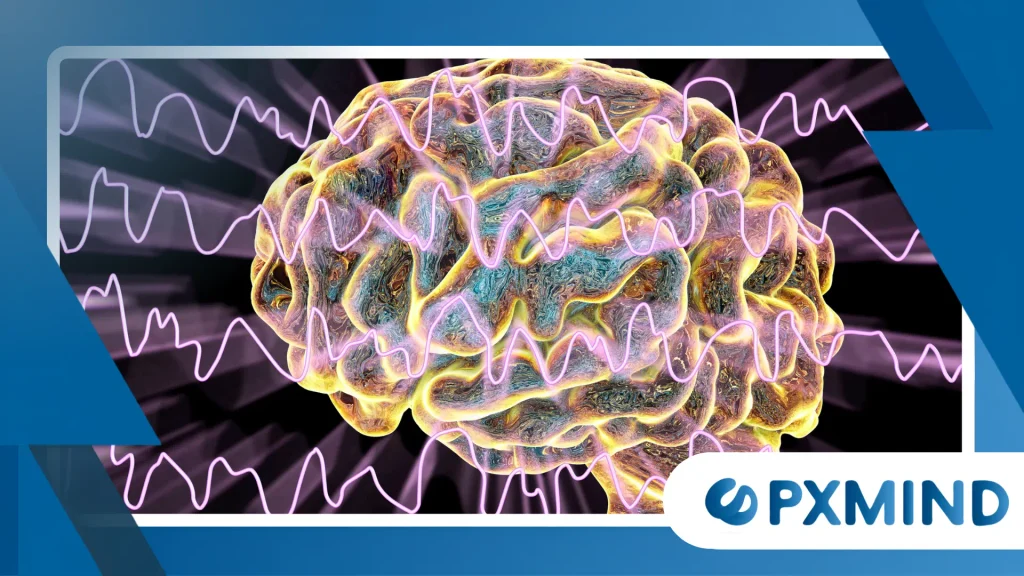
Aperiodic brain activity refers to the scale-free, non-oscillatory component of neural electrical signals.
Unlike periodic oscillations that repeat at specific frequencies (such as an 8–12 Hz alpha rhythm), aperiodic signals span across all measured frequencies without a distinct period.
In power spectral density (PSD) plots, aperiodic activity creates a characteristic 1/f-like distribution, where power decreases exponentially as frequency increases.
Modern neuroimaging toolkits separate these broadband signals into two main parameters: the offset (overall baseline power) and the exponent (the steepness of the spectral slope).
A complete neural signal is comprised of periodic oscillations (the visible spectral peaks) added directly onto this underlying aperiodic component (the 1/f slope).
Neuroscientists previously applied band-pass filtering to isolate specific oscillatory rhythms, unintentionally confounding aperiodic slope shifts with changes in periodic power.
Advanced analytical software, such as the SpecParam algorithm hosted on GitHub, allows researchers to parametrize neural power spectra into distinct periodic and aperiodic components.
How Does Aperiodic Activity Impact Neural Communication?
Cortical networks require a delicate equilibrium between excitatory glutamatergic signaling and inhibitory GABAergic signaling to process information efficiently.
Aperiodic activity directly indexes this excitation-to-inhibition (E/I) balance across local neural populations.
When inhibitory tone dominates, the spectral slope steepens, resulting in a higher aperiodic exponent.
++ How Successive Relearning Builds Stronger Memory That Lasts Longer
Conversely, increased excitatory signaling flattens the slope, lowering the exponent. This physiological relationship provides a non-invasive window into micro-circuit dynamics.
- High Inhibitory Tone (GABA): Produces a steep slope and a higher exponent.
- High Excitatory Tone (Glutamate): Produces a flat slope and a lower exponent.
Optimal cognitive processing requires flexible shifting between baseline inhibitory control and targeted excitation.
Excessive background excitation degrades signal-to-noise ratios, impairing precise neural communication.
A stable, well-regulated aperiodic baseline ensures that transient oscillatory signals transmit meaningful information across interconnected brain regions.
How Does Aperiodic Brain Activity Relate to Human Cognition?
Human cognitive performance relies heavily on dynamic neural tuning.
Research demonstrates that aperiodic brain activity correlates directly with core cognitive domains, serving as a functional readout of processing efficiency and computational capacity.
Working Memory and Executive Function
Working memory capacity depends on the precise gating of sensory input and maintenance of internal representations.
Higher aperiodic exponents—reflecting stronger inhibitory control—correlate with superior working memory capacity and enhanced cognitive control in healthy adults.
Read more: Why Interoceptive Awareness Matters for Brain Function
Flattened slopes, indicating elevated background neural noise, predict higher error rates in complex task-switching environments.
Processing Speed and Task Engagement
During active problem-solving, local cortical networks adjust their spectral slope.
As task difficulty increases, healthy brains show localized flattening of the aperiodic exponent, signaling temporary increases in local excitation required for rapid information processing.
++ Closing rituals: stop taking work home every day
Once the task concludes, the exponent rapidly restores to its steeper baseline.

Attention and Information Processing
Attentional focus requires suppressing task-irrelevant cortical areas while activating relevant sensory networks.
Aperiodic dynamics capture these spatial adjustments across cortical hierarchies.
Inattention often corresponds to an inability to maintain stable slope gradients between prefrontal executive networks and sensory cortices.
How Do Aperiodic Parameters Compare Across Cognitive States?
The table below summarizes how aperiodic parameters systematically shift across different life stages, cognitive states, and clinical profiles.
| Domain / State | Aperiodic Exponent (Slope) | Aperiodic Offset (Power) | Physiological Significance |
| Healthy Young Adults | Steep (Optimal) | Moderate | Balanced E/I ratio; high signal-to-noise ratio |
| Healthy Aging | Flatter (Decreased) | Reduced | Reduced GABAergic inhibition; elevated neural noise |
| High Cognitive Load | Dynamically Flattened | Elevated | Increased local excitation for information processing |
| ADHD Profiles | Significantly Flatter | Variable | Reduced cortical inhibition; impaired attentional gating |
| Anesthesia / Deep Sleep | Highly Steepened | Elevated | Dominant inhibitory signaling; suppressed consciousness |
Why Is Aperiodic Activity Crucial for Understanding Aging and Disease?
Historically, researchers attributed age-related cognitive decline primarily to reductions in alpha wave power or theta wave slowing.
Disentangling aperiodic activity from periodic oscillations has significantly revised these clinical models.
Healthy Aging vs. Pathological Decline
As adults age, the brain’s baseline spectral slope naturally flattens.
This flattening reflects a gradual loss of GABAergic inhibitory interneurons, leading to increased background neural noise (the neural noise hypothesis of aging). The aging cascade follows a distinct biological progression:
GABAergic Decline: Gradual loss of inhibitory signaling interneurons.
Flatter Aperiodic Slope: Shift toward a lower exponent across cortical networks.
Increased Neural Noise: Elevation of uncoordinated background excitation.
Cognitive Slowing: Slower processing speeds and reduced working memory gating.
Older adults with steeper, youth-like aperiodic exponents typically demonstrate preserved processing speed and superior memory retention.
Clarifying Biomarkers in Neurodevelopmental Disorders
In neurodevelopmental conditions like ADHD, traditional electrophysiological metrics often pointed to an elevated theta/beta ratio (TBR).
Modern re-analyses reveal that this elevated ratio frequently stems from a flatter aperiodic slope rather than an actual increase in rhythmic theta oscillations.
By isolating the true aperiodic component, clinicians gain more accurate biomarkers for diagnostic evaluation and targeted pharmacological interventions.
Further research details on neural oscillations and brain health are maintained by the National Institute of Neurological Disorders and Stroke, serving as a standard resource for neuroscientific progress.

How Do Researchers Measure and Isolate Aperiodic Signals?
Accurate measurement of aperiodic activity requires parameterizing the electrophysiological power spectrum into distinct periodic and aperiodic components:
Data Acquisition: High-density EEG or MEG arrays collect raw time-series data during resting-state or task-based paradigms.
Spectral Transformation: Fast Fourier Transform (FFT) or Welch’s method converts time-series data into the frequency domain, displaying power across frequencies.
Model Fitting: Specialized algorithms fit a broadband function across the spectrum to estimate the offset (overall shift in power across frequencies), the exponent (the steepness of the 1/f slope), and the knee parameter (reflecting bend frequency in broad spectra).
Oscillation Extraction: Gaussian peaks fitting above the modeled aperiodic baseline isolate true rhythmic oscillations (e.g., alpha, beta) without broadband contamination.
Frequently Asked Questions
Is aperiodic brain activity just background noise?
No. While long considered visual static, aperiodic activity is a biologically meaningful signal.
It directly reflects the baseline excitation-to-inhibition (E/I) balance of neural populations and correlates strongly with cognitive performance, age, and neurological health.
How does aperiodic activity differ from periodic brain waves?
Periodic brain waves are rhythmic oscillations that repeat at specific frequencies, such as alpha (8–12 Hz) or beta (13–30 Hz) waves.
Aperiodic activity is non-oscillatory broadband energy distributed continuously across the entire frequency spectrum following a 1/f pattern.
Can aperiodic brain activity be altered through training or interventions?
Preliminary evidence suggests that targeted interventions such as neurofeedback, transcranial magnetic stimulation (TMS), pharmacological agents affecting GABA/glutamate systems, and cognitive training can influence local aperiodic slopes, potentially restoring optimal E/I balance.
Understanding the role of aperiodic brain activity represents a major advance in cognitive neuroscience.
By separating scale-free background signals from rhythmic oscillations, researchers now possess a precise, non-invasive method for evaluating E/I balance, tracking age-related neural changes, and refining clinical diagnosis for neurodevelopmental disorders.
As analytical methods continue to mature, measuring aperiodic dynamics will remain central to decoding the neural foundations of human intelligence.
++ Exploring neurodevelopment through oscillatory and aperiodic EEG activity
