
Cómo convertir el conocimiento en habilidades prácticas
Discovering how to turn knowledge into real-world skills fundamentally transforms passive learning into dynamic, tangible professional success.
Anuncios
Mastering this transition separates true experts from mere academic enthusiasts in today’s hyper-competitive economy.
Navigating the gap between theory and execution requires structured frameworks and deliberate practice.
Review our comprehensive guide below to unlock actionable strategies for immediate skill acquisition and profound cognitive mastery.
Tabla de contenido
- Why is Action Crucial for Retention?
- How Does Deliberate Practice Work?
- What Are the Latest Learning Statistics?
- How Do Mental Models Accelerate Application?
- Preguntas frecuentes
- Conclusion and Next Steps for Ultimate Mastery
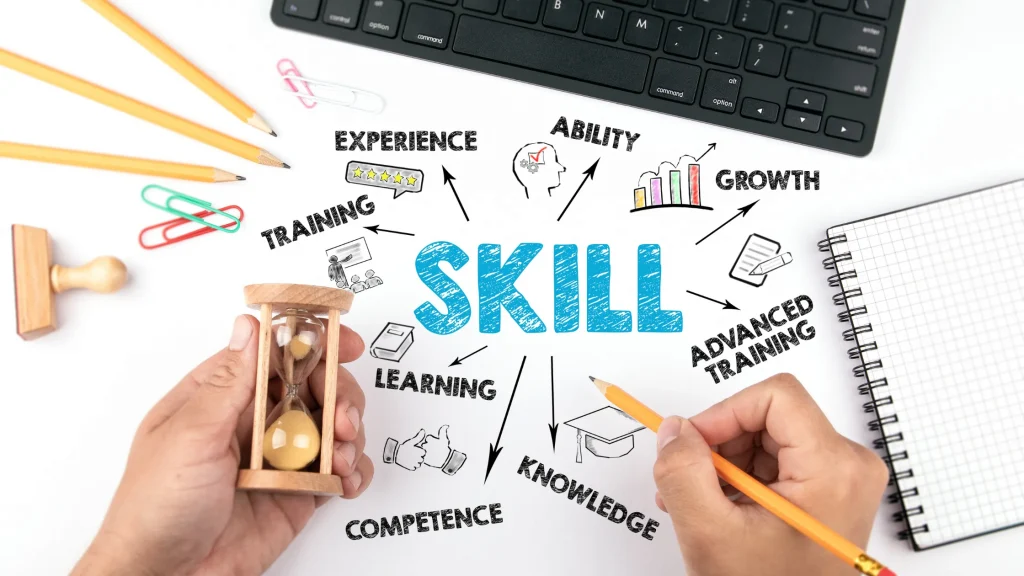
Why is Action Crucial for Retention?
Understanding psychological mechanics reveals why passive reading rarely yields tangible capabilities.
Human brains discard unused information rapidly, making immediate application the only reliable method for cementing complex theoretical concepts permanently.
Engaging actively with fresh material forces neural pathways to strengthen significantly.
Professionals testing new theories build robust mental architectures that withstand the pressures of actual professional environments daily.
Implementing small, low-risk experiments allows learners to validate their understanding safely.
Gathering immediate feedback from these initial attempts highlights blind spots that purely theoretical study will completely miss.
Anyone attempting to turn knowledge into real-world skills must embrace initial failures.
Mistakes made during early practical applications provide the highest density of actionable data for rapid, effective behavioral correction.
Educational researchers consistently demonstrate that active recall outpaces passive review dramatically.
Testing your abilities without referencing source material forces your brain to reconstruct information, heavily solidifying long-term memory structures.
How Does Deliberate Practice Work?
Purposeful repetition remains the cornerstone of elite performance across all disciplines.
Unlike mindless rote memorization, deliberate practice requires intense focus, specific goals, and constant adjustments based on immediate performance feedback.
Breaking down complex abilities into manageable micro-skills drastically accelerates the learning curve.
Tackling one isolated component at a time prevents cognitive overload and ensures higher quality execution during integration phases.
Seeking critical evaluation from experienced mentors offers invaluable insights into subtle errors.
External perspectives quickly identify inefficiencies that self-taught individuals practice incorrectly for years without even noticing them.
Professionals looking to turn knowledge into real-world skills must track their progress meticulously.
Quantifiable metrics provide objective evidence of improvement, preventing motivational dips during frustrating plateaus in the learning cycle.
Pushing slightly beyond current capabilities triggers necessary neuroplasticity for growth.
Staying inside a comfortable competence zone feels safe but ultimately guarantees stagnation in a rapidly evolving global marketplace.
Consistency beats erratic bursts of intense effort every single time.
Dedicating twenty focused minutes daily yields significantly better results than attempting a grueling five-hour session once a month.
Leveraging established psychological frameworks optimizes your practice routines beautifully.
El Institutos Nacionales de Salud offers extensive research detailing how spaced repetition drastically improves long-term skill retention and practical daily application.
What Are the Latest Learning Statistics?
Analyzing current educational data highlights the massive disparity between consumption and execution.
Recent studies clearly emphasize that traditional classroom models frequently fail to produce competent, field-ready practitioners upon graduation.
Empirical evidence from 2026 workplace performance reviews paints a clear picture.
Organizations investing heavily in immersive, scenario-based training report substantially higher employee competency rates compared to lecture-based programs.
++ Cómo la codificación semántica mejora el aprendizaje sin necesidad de más tiempo.
Studying the following table outlines retention rates based on specific instructional methodologies.

Reviewing these figures demonstrates precisely why interactive, experiential methodologies dominate modern professional development frameworks worldwide.
| Primary Learning Methodology | Passive Retention Rate | Active Execution Rate | 2026 Workforce Efficacy Level |
| Lecture Only | 15% | 8% | Bajo |
| Reading Material | 20% | 12% | Bajo |
| Audio Visual | 30% | 18% | Moderado |
| Group Discussion | 40% | 35% | Moderado |
| Demonstration | 50% | 45% | Moderado |
| Mentorship Sessions | 60% | 55% | Alto |
| Practice by Doing | 75% | 82% | Alto |
| Teaching Others | 90% | 95% | Excepcional |
Utilizing these statistics to turn knowledge into real-world skills requires immediate pedagogical shifts.
Individuals must intentionally design their personal development plans around high-efficacy activities like teaching peers and hands-on execution.
Corporate training budgets increasingly reflect this statistical reality.
Leer más: Por qué la práctica de recuerdo diferido fortalece el almacenamiento de la memoria
Forward-thinking companies actively eliminate passive seminars, replacing them with intensive workshops demanding real-time problem-solving and immediate prototype generation models.
How Do Mental Models Accelerate Application?
Cognitive frameworks act as interpretive lenses for navigating complex scenarios.
By internalizing diverse mental models, practitioners quickly categorize novel problems and apply previously successful solutions with remarkable speed.
Cross-pollinating ideas between distinct industries sparks incredible innovation naturally.
A biological mental model applied to software engineering often yields robust, adaptive architectures that standard programming paradigms completely overlook.
Building a latticework of fundamental truths gives raw data profound contextual meaning.
When facts connect to broader structural concepts, they become powerful tools rather than isolated, useless trivia points.
Visualizing desired outcomes establishes clear directional goals for your cognitive journey.
Mental simulations prepare neurological pathways for physical execution, bridging the gap between imagination and reality seamlessly.
Those aiming to turn knowledge into real-world skills leverage models like First Principles thinking.
Deconstructing complex problems into foundational truths removes assumptions, allowing for highly original, effective practical solutions.
Inversion represents another crucial framework for practical execution.
Instead of planning how to achieve success, carefully calculating how to guarantee failure highlights exactly which pitfalls to actively avoid.
Applying the Pareto Principle dictates that minority inputs often drive majority outputs.
Identifying the exact twenty percent of a task that produces eighty percent of results optimizes early learning phases.
Second-order thinking forces practitioners to consider the downstream consequences of their actions.
++ Por qué las técnicas de distanciamiento social mejoran el equilibrio emocional
This advanced model prevents short-sighted solutions that create significantly worse problems during the subsequent implementation stages.

Preguntas frecuentes
Many learners struggle with the initial transition from theory to practice.
Our team curated these common inquiries to clarify ambiguities and streamline your personal cognitive development journey effectively.
Why do I forget information so quickly after reading?
Brains naturally prune unused synaptic connections to conserve energy.
Unless you actively turn knowledge into real-world skills immediately, your neurological systems flag the information as irrelevant and discard it.
How much time should I spend practicing versus studying?
Elite educators universally recommend a twenty-to-eighty ratio for maximum efficacy.
Spend exactly twenty percent of your allocated time absorbing theory, dedicating the remaining eighty percent strictly to active execution.
What if I make mistakes during the practice phase?
Errors serve as the most crucial navigational beacons during development.
Embrace them entirely, analyze the root causes objectively, and adjust your approach immediately for subsequent successful iterations.
Can I master complex subjects without formal university education?
Absolutely, provided you design rigorous, self-directed experiential learning environments.
The modern digital landscape offers limitless theoretical resources, making structured practical application the only remaining barrier to true mastery.
Conclusión
Transforming abstract concepts into tangible capabilities demands unrelenting focus and discipline.
Theoretical blueprints hold zero intrinsic value until capable hands meticulously execute them within unforgiving, dynamic environments.
Effectively executing the strategies outlined above will definitively turn knowledge into real-world skills rapidly.
Start immediately by selecting one theoretical concept you recently acquired and testing it physically today.
Continual growth requires integrating reputable methodologies into your daily routines.
For further insights on cognitive behavioral frameworks, explore resources provided by the Asociación Americana de Psicología to refine your techniques.
++ Turn Classroom Knowledge into Real-World Impacts
++ From Curriculum To Capability: Turning Theoretical Knowledge Into Actionable Skills